Table of Content
Title


Take Control of Your
Mental Well-Being
Professional support that helps you feel balanced and empowered.

Take Control of Your
Mental Well-Being
Professional support that helps you feel balanced and empowered.
Take Control of Your
Mental Well-Being
Professional support that helps you feel balanced and empowered.
How to Re-Engage Someone Who Dropped Out of Treatment
How to Re-Engage Someone Who Dropped Out of Treatment
How to Re-Engage Someone Who Dropped Out of Treatment
How to Re-Engage Someone Who Dropped Out of Treatment
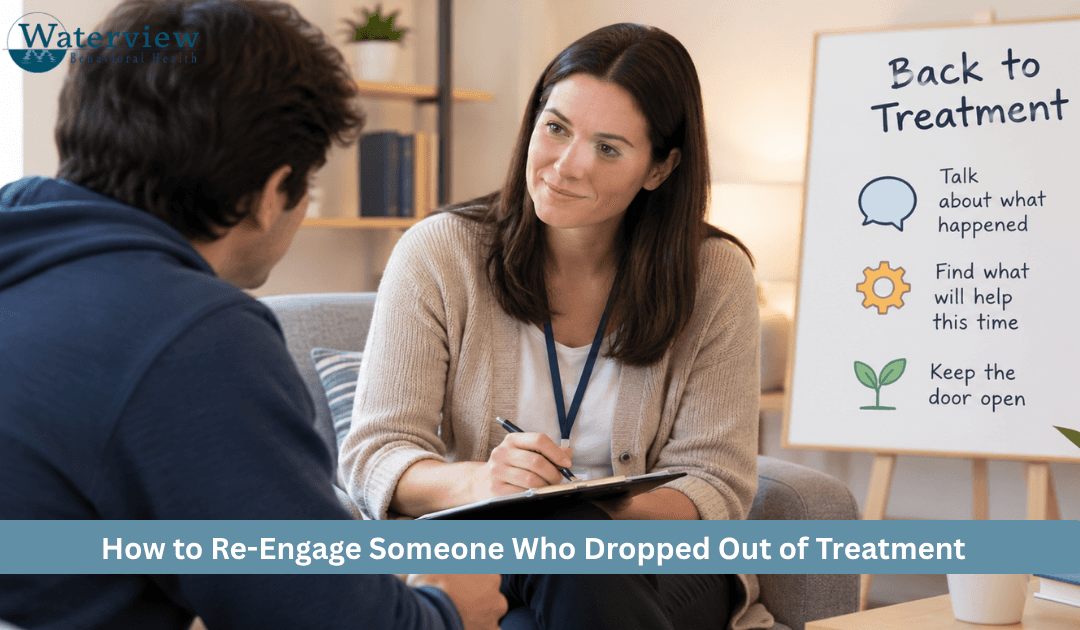
When someone drops out of mental health or substance use treatment, it stirs discouragement for everyone involved. The person may feel embarrassed, maybe even convinced they "failed." Family members start to worry that treatment will never work for their loved one. And referring providers quietly wonder if they missed something: a warning sign, the wrong level of care, something.
Here's the thing, though: dropout isn't rare, and it isn't the same as failure. Early discontinuation shows up constantly across outpatient mental health and substance use of care. People leave for all kinds of reasons, including a scheduling conflict, symptoms getting worse instead of better, doubt about whether recovery is even possible, a program that just didn't click, money problems, or one too many competing responsibilities pulling them away.
Re-engagement starts by trading blame for curiosity. Instead of asking "why didn't they stick with it?" try "what got in the way, and what would need to change this time?"
That small shift matters more than it sounds like it should. For clinicians, families, and referral partners alike, it keeps the door open. It also makes the next attempt sharper: more realistic, more tailored to what actually happened the first time around.
Dropping Out Doesn't Mean Treatment Can't Work
It's easy to read an interrupted treatment episode as proof that treatment itself didn't work. But that conclusion usually stretches further than the evidence supports. Maybe the person only made it to a handful of sessions before life got in the way. Maybe they were referred while symptoms were still too acute to really show up and participate. Maybe someone else pushed them into it before they were ready. Or maybe the schedule, the group, the level of care, or the whole therapeutic approach just wasn't right for them.
None of that means the attempt wasted. It still told everyone something: what the person can tolerate, what kind of support they actually need, which barriers hit hardest, what kind of care might fit better next time. Even a short stint in treatment can leave behind something useful, like a skill or two, a bit of insight. Maybe some trust built with a provider that doesn't have to start over from scratch.
A better way to think about it: the first attempt got interrupted. It doesn't mean it's over. It means the next one needs adjusting.
Start With Curiosity, Not Pressure
The first conversation about coming back should feel like an open door, not a confrontation. For providers, something simple and direct tends to work best: "I noticed you weren't able to continue with the program, and I wanted to check in and understand what happened."
That question does a lot of quiet work. It shows concern without piling on shame. It gives the person space to say whether the problem was practical, emotional, clinical, relational, or just a bad fit. And it stops the conversation from turning into an argument about whether they "should" come back before anyone's even figured out why they left in the first place.
Families can lean on the same idea. "What happened?" tends to land a lot better than "when are you going back?" One invites honesty. The other can put someone on the defensive fast, especially if they're already carrying guilt or feeling overwhelmed.
Once the person feels heard, that's when the conversation can move toward what's next: what's changed, what still feels hard, what kind of support would actually help, and whether the same program still makes sense or a different setting might serve them better.
Identify the Reason Treatment Stopped
Re-engagement only works if the response actually matches why someone left. A logistical problem needs a logistical fix. A clinical setback might call for stabilization or a different level of care. A bad fit needs a closer look at the program itself. And ambivalence needs a completely different kind of conversation.
Logistical barriers get overlooked more than they should. Transportation, childcare, work hours, insurance headaches, money, family obligations: any one of these can quietly derail attendance. When this is what's really going on, the person probably isn't rejecting treatment at all. They just couldn't keep up with the structure as it was set up. Sometimes all it takes is a more flexible schedule, help getting to and from sessions, or a program format that actually fits how their life works.
Clinical barriers can pull someone out of care just as easily. Depression or anxiety getting worse, trauma symptoms flaring, substance use escalating, medication side effects, sleep falling apart, some acute stressor hitting out of nowhere: any of these can make it hard to keep showing up. When this is the case, it usually means the person needed more support than what was available at the time. Before sending someone back into an intensive outpatient program, it's worth reassessing safety, symptom severity, medications, substance use, and whether more stabilization is needed first.
Fit and engagement issues deserve real attention too, not a dismissive shrug. Maybe the group didn't feel clinically relevant. Maybe the schedule wasn't sustainable, the therapist's style didn't click, or the program just wasn't built around what this person actually needed. That's not resistance. That's useful information. Not every program works for every person, and not every IOP looks the same.
Ambivalence shows up more often than people admit. Some folks start treatment because a family member, employer, court, school, or doctor pushed them into it. Others know they need help but aren't fully sold on changing. If nobody talks through that uncertainty early on, it tends to resurface the moment treatment gets hard. Re-engaging someone like this usually calls for a slower conversation, one about goals, about readiness, about what they actually want their life to look like if this is going to be worth it.
Reassess Before Recommending the Same Plan
It's tempting to just tell someone to go back to whatever they were doing before. Sometimes that's fine. But it's worth pausing first to ask what's actually different now.
A few honest questions can go a long way: What made it hard to show up before? Are those same obstacles still there? Have symptoms shifted? Has substance use gotten worse, gotten better, or become harder to predict? Is there more motivation now than there was at intake? Did the last program even feel relevant to what this person needed? Was the level of care too much, too little, or just badly timed?
For referral partners especially, this step matters. It's how you avoid sending someone right back into the same mismatch. If a work schedule causes the original dropout, don't refer back into the same daytime slot. If symptoms spiral quickly, maybe a higher level of stabilization needs to come first. If the group itself was the problem, a different track or population or clinical focus might be worth exploring.
None of this is about punishing someone for leaving. It's about treating the dropout as data, not a verdict.

Help the Person Preserve Hope
People who drop out of treatment tend to carry a fair amount of shame around it. "I already tried therapy." "IOP didn't work for me." "I'm just not good at treatment." Those lines deserve real attention, because they can quietly become the thing that keeps someone from trying again.
A good response validates how hard it was without agreeing that recovery is out of reach. Something like: "It makes sense that it felt discouraging when you couldn't keep going. It's also worth looking at what got in the way. An interrupted attempt doesn't mean treatment can't help you."
Language like that protects someone's dignity. It turns the next step into problem-solving instead of starting over from nothing.
Providers and families alike should steer clear of shame as a motivator. Comments like "you wasted the opportunity" or "you never follow through" tend to backfire, pushing people further away instead of closer. People are far more likely to come back and be honest when they feel respected, not judged.
Match the Next Step to the Current Need
Someone coming back after a dropout might need the exact same level of care, a tweaked version of it, or something entirely different. What's right depends on where they're at now: symptoms, safety, day-to-day functioning, motivation, and whatever barriers are still standing.
For some, going back into intensive outpatient care with a bit more support built in is enough, things like help with transportation, a therapist coordinating in the background,medication check-ins,family involvement where it makes sense, a schedule that's actually realistic this time. Others might need a different kind of outpatient program altogether, one built around trauma, mood symptoms, anxiety,co-occurring disorders, or family dynamics that the last program didn't touch.
And some people genuinely need more than outpatient care can offer right now. If someone's medically unstable, at real risk, unable to keep themselves safe, or too symptomatic to participate meaningfully, they need a higher level of care first. Re-engagement should always be clinically sound, never just the path of least resistance.
The bottom line: don't force everyone into the same box. Someone leaving treatment tells you something happened. The next plan should actually respond to whatever that was.
How Referral Partners Can Support Re-Engagement
Referral partners often have more leverage here than they realize. A trusted therapist, psychiatrist, primary care doctor, discharge planner, or case manager can reopen this conversation in a way that feels a lot less loaded than it might coming from family.
The best referral conversations get specific instead of generic. Rather than "you need to go back," something like this tends to land better: "It sounds like the schedule and the group didn't work well last time. Would you be open to a program that could look at that more carefully and figure out what would actually be realistic for you?"
That kind of framing tells the person their past experience actually mattered. It wasn't ignored. It positions this next step as smarter, not just a repeat of something that already didn't work.
When it's possible, referral partners can also pass along relevant, non-confidential context to the next program, with proper consent, of course. Details about past barriers, motivation, symptom patterns, co-occurring concerns, or scheduling limits can help the next team connect with the person faster and more effectively.
How Waterview Behavioral Health Can Help
Waterview Behavioral Health, based in Wallingford, Connecticut, offers structured intensive outpatient care for adults who need more than weekly outpatient therapy can provide. If someone has stepped away from treatment before, our clinical team works with them to figure out what happened, what's changed since, and what level of support actually makes sense now.
Our program covers evidence-based care for mental health and co-occurring substance use concerns, with real attention paid to the practical and clinical stuff that gets in the way of engagement. A prior dropout isn't something we hold against someone. It's information we use to build a better plan the second time around.
For referral partners, we're always open to a collaborative conversation about whether IOP fits a particular patient's current situation. We can talk through program structure, clinical appropriateness, and referral considerations, all while keeping privacy and consent front and center. And if IOP turns out not to be the right fit, that's useful too. It just means pointing someone toward the level of care they actually need.
Frequently Asked Questions
Is dropping out of treatment common?
Honestly, yes, way more common than people assume. It happens all the time across outpatient mental health and substance use care. That doesn't mean it should get brushed off, but it also shouldn't be read as some kind of failure or proof the person just didn't care enough
What should I say to someone who left treatment early?
Lead with curiosity, not a lecture. Something as simple as "I noticed you weren't able to continue, and I wanted to understand what happened" goes a long way. People tend to open up when they don't feel like they're being cornered. Hold off on the blame and the immediate problem-solving until they've actually had a chance to tell their side of it.
Should someone return to the same program after dropping out?
Depends. Sometimes it makes sense, sometimes it doesn't. It really comes down to why they left in the first place. If it was something logistical, say, a schedule that no longer works, and that's been sorted out, going back can be the right call. But if the real issue was fit, symptom severity, or the level of care itself, it's worth taking a step back before just repeating the same plan.
Does leaving IOP mean a person needs residential treatment?
Not at all, not automatically anyway. Whether residential care makes sense depends on a lot of factors: how someone's doing symptom-wise right now, whether they're safe, how they're functioning day to day, what their substance use looks like, who's around to support them, and whether they're actually in a place to engage with treatment.
Can a person have a better outcome the second time they try treatment?
Definitely, and it happens more than you'd think. Once the barriers that tripped things up the first time actually get named and dealt with, re-engagement tends to go a lot smoother. In some ways, that first attempt wasn't a waste at all. It just ended up being the information needed to build something that actually fits this time around.
When someone drops out of mental health or substance use treatment, it stirs discouragement for everyone involved. The person may feel embarrassed, maybe even convinced they "failed." Family members start to worry that treatment will never work for their loved one. And referring providers quietly wonder if they missed something: a warning sign, the wrong level of care, something.
Here's the thing, though: dropout isn't rare, and it isn't the same as failure. Early discontinuation shows up constantly across outpatient mental health and substance use of care. People leave for all kinds of reasons, including a scheduling conflict, symptoms getting worse instead of better, doubt about whether recovery is even possible, a program that just didn't click, money problems, or one too many competing responsibilities pulling them away.
Re-engagement starts by trading blame for curiosity. Instead of asking "why didn't they stick with it?" try "what got in the way, and what would need to change this time?"
That small shift matters more than it sounds like it should. For clinicians, families, and referral partners alike, it keeps the door open. It also makes the next attempt sharper: more realistic, more tailored to what actually happened the first time around.
Dropping Out Doesn't Mean Treatment Can't Work
It's easy to read an interrupted treatment episode as proof that treatment itself didn't work. But that conclusion usually stretches further than the evidence supports. Maybe the person only made it to a handful of sessions before life got in the way. Maybe they were referred while symptoms were still too acute to really show up and participate. Maybe someone else pushed them into it before they were ready. Or maybe the schedule, the group, the level of care, or the whole therapeutic approach just wasn't right for them.
None of that means the attempt wasted. It still told everyone something: what the person can tolerate, what kind of support they actually need, which barriers hit hardest, what kind of care might fit better next time. Even a short stint in treatment can leave behind something useful, like a skill or two, a bit of insight. Maybe some trust built with a provider that doesn't have to start over from scratch.
A better way to think about it: the first attempt got interrupted. It doesn't mean it's over. It means the next one needs adjusting.
Start With Curiosity, Not Pressure
The first conversation about coming back should feel like an open door, not a confrontation. For providers, something simple and direct tends to work best: "I noticed you weren't able to continue with the program, and I wanted to check in and understand what happened."
That question does a lot of quiet work. It shows concern without piling on shame. It gives the person space to say whether the problem was practical, emotional, clinical, relational, or just a bad fit. And it stops the conversation from turning into an argument about whether they "should" come back before anyone's even figured out why they left in the first place.
Families can lean on the same idea. "What happened?" tends to land a lot better than "when are you going back?" One invites honesty. The other can put someone on the defensive fast, especially if they're already carrying guilt or feeling overwhelmed.
Once the person feels heard, that's when the conversation can move toward what's next: what's changed, what still feels hard, what kind of support would actually help, and whether the same program still makes sense or a different setting might serve them better.
Identify the Reason Treatment Stopped
Re-engagement only works if the response actually matches why someone left. A logistical problem needs a logistical fix. A clinical setback might call for stabilization or a different level of care. A bad fit needs a closer look at the program itself. And ambivalence needs a completely different kind of conversation.
Logistical barriers get overlooked more than they should. Transportation, childcare, work hours, insurance headaches, money, family obligations: any one of these can quietly derail attendance. When this is what's really going on, the person probably isn't rejecting treatment at all. They just couldn't keep up with the structure as it was set up. Sometimes all it takes is a more flexible schedule, help getting to and from sessions, or a program format that actually fits how their life works.
Clinical barriers can pull someone out of care just as easily. Depression or anxiety getting worse, trauma symptoms flaring, substance use escalating, medication side effects, sleep falling apart, some acute stressor hitting out of nowhere: any of these can make it hard to keep showing up. When this is the case, it usually means the person needed more support than what was available at the time. Before sending someone back into an intensive outpatient program, it's worth reassessing safety, symptom severity, medications, substance use, and whether more stabilization is needed first.
Fit and engagement issues deserve real attention too, not a dismissive shrug. Maybe the group didn't feel clinically relevant. Maybe the schedule wasn't sustainable, the therapist's style didn't click, or the program just wasn't built around what this person actually needed. That's not resistance. That's useful information. Not every program works for every person, and not every IOP looks the same.
Ambivalence shows up more often than people admit. Some folks start treatment because a family member, employer, court, school, or doctor pushed them into it. Others know they need help but aren't fully sold on changing. If nobody talks through that uncertainty early on, it tends to resurface the moment treatment gets hard. Re-engaging someone like this usually calls for a slower conversation, one about goals, about readiness, about what they actually want their life to look like if this is going to be worth it.
Reassess Before Recommending the Same Plan
It's tempting to just tell someone to go back to whatever they were doing before. Sometimes that's fine. But it's worth pausing first to ask what's actually different now.
A few honest questions can go a long way: What made it hard to show up before? Are those same obstacles still there? Have symptoms shifted? Has substance use gotten worse, gotten better, or become harder to predict? Is there more motivation now than there was at intake? Did the last program even feel relevant to what this person needed? Was the level of care too much, too little, or just badly timed?
For referral partners especially, this step matters. It's how you avoid sending someone right back into the same mismatch. If a work schedule causes the original dropout, don't refer back into the same daytime slot. If symptoms spiral quickly, maybe a higher level of stabilization needs to come first. If the group itself was the problem, a different track or population or clinical focus might be worth exploring.
None of this is about punishing someone for leaving. It's about treating the dropout as data, not a verdict.
Help the Person Preserve Hope
People who drop out of treatment tend to carry a fair amount of shame around it. "I already tried therapy." "IOP didn't work for me." "I'm just not good at treatment." Those lines deserve real attention, because they can quietly become the thing that keeps someone from trying again.
A good response validates how hard it was without agreeing that recovery is out of reach. Something like: "It makes sense that it felt discouraging when you couldn't keep going. It's also worth looking at what got in the way. An interrupted attempt doesn't mean treatment can't help you."
Language like that protects someone's dignity. It turns the next step into problem-solving instead of starting over from nothing.
Providers and families alike should steer clear of shame as a motivator. Comments like "you wasted the opportunity" or "you never follow through" tend to backfire, pushing people further away instead of closer. People are far more likely to come back and be honest when they feel respected, not judged.
Match the Next Step to the Current Need
Someone coming back after a dropout might need the exact same level of care, a tweaked version of it, or something entirely different. What's right depends on where they're at now: symptoms, safety, day-to-day functioning, motivation, and whatever barriers are still standing.
For some, going back into intensive outpatient care with a bit more support built in is enough, things like help with transportation, a therapist coordinating in the background,medication check-ins,family involvement where it makes sense, a schedule that's actually realistic this time. Others might need a different kind of outpatient program altogether, one built around trauma, mood symptoms, anxiety,co-occurring disorders, or family dynamics that the last program didn't touch.
And some people genuinely need more than outpatient care can offer right now. If someone's medically unstable, at real risk, unable to keep themselves safe, or too symptomatic to participate meaningfully, they need a higher level of care first. Re-engagement should always be clinically sound, never just the path of least resistance.
The bottom line: don't force everyone into the same box. Someone leaving treatment tells you something happened. The next plan should actually respond to whatever that was.
How Referral Partners Can Support Re-Engagement
Referral partners often have more leverage here than they realize. A trusted therapist, psychiatrist, primary care doctor, discharge planner, or case manager can reopen this conversation in a way that feels a lot less loaded than it might coming from family.
The best referral conversations get specific instead of generic. Rather than "you need to go back," something like this tends to land better: "It sounds like the schedule and the group didn't work well last time. Would you be open to a program that could look at that more carefully and figure out what would actually be realistic for you?"
That kind of framing tells the person their past experience actually mattered. It wasn't ignored. It positions this next step as smarter, not just a repeat of something that already didn't work.
When it's possible, referral partners can also pass along relevant, non-confidential context to the next program, with proper consent, of course. Details about past barriers, motivation, symptom patterns, co-occurring concerns, or scheduling limits can help the next team connect with the person faster and more effectively.
How Waterview Behavioral Health Can Help
Waterview Behavioral Health, based in Wallingford, Connecticut, offers structured intensive outpatient care for adults who need more than weekly outpatient therapy can provide. If someone has stepped away from treatment before, our clinical team works with them to figure out what happened, what's changed since, and what level of support actually makes sense now.
Our program covers evidence-based care for mental health and co-occurring substance use concerns, with real attention paid to the practical and clinical stuff that gets in the way of engagement. A prior dropout isn't something we hold against someone. It's information we use to build a better plan the second time around.
For referral partners, we're always open to a collaborative conversation about whether IOP fits a particular patient's current situation. We can talk through program structure, clinical appropriateness, and referral considerations, all while keeping privacy and consent front and center. And if IOP turns out not to be the right fit, that's useful too. It just means pointing someone toward the level of care they actually need.
Frequently Asked Questions
Is dropping out of treatment common?
Honestly, yes, way more common than people assume. It happens all the time across outpatient mental health and substance use care. That doesn't mean it should get brushed off, but it also shouldn't be read as some kind of failure or proof the person just didn't care enough
What should I say to someone who left treatment early?
Lead with curiosity, not a lecture. Something as simple as "I noticed you weren't able to continue, and I wanted to understand what happened" goes a long way. People tend to open up when they don't feel like they're being cornered. Hold off on the blame and the immediate problem-solving until they've actually had a chance to tell their side of it.
Should someone return to the same program after dropping out?
Depends. Sometimes it makes sense, sometimes it doesn't. It really comes down to why they left in the first place. If it was something logistical, say, a schedule that no longer works, and that's been sorted out, going back can be the right call. But if the real issue was fit, symptom severity, or the level of care itself, it's worth taking a step back before just repeating the same plan.
Does leaving IOP mean a person needs residential treatment?
Not at all, not automatically anyway. Whether residential care makes sense depends on a lot of factors: how someone's doing symptom-wise right now, whether they're safe, how they're functioning day to day, what their substance use looks like, who's around to support them, and whether they're actually in a place to engage with treatment.
Can a person have a better outcome the second time they try treatment?
Definitely, and it happens more than you'd think. Once the barriers that tripped things up the first time actually get named and dealt with, re-engagement tends to go a lot smoother. In some ways, that first attempt wasn't a waste at all. It just ended up being the information needed to build something that actually fits this time around.
Latest News
Latest News