
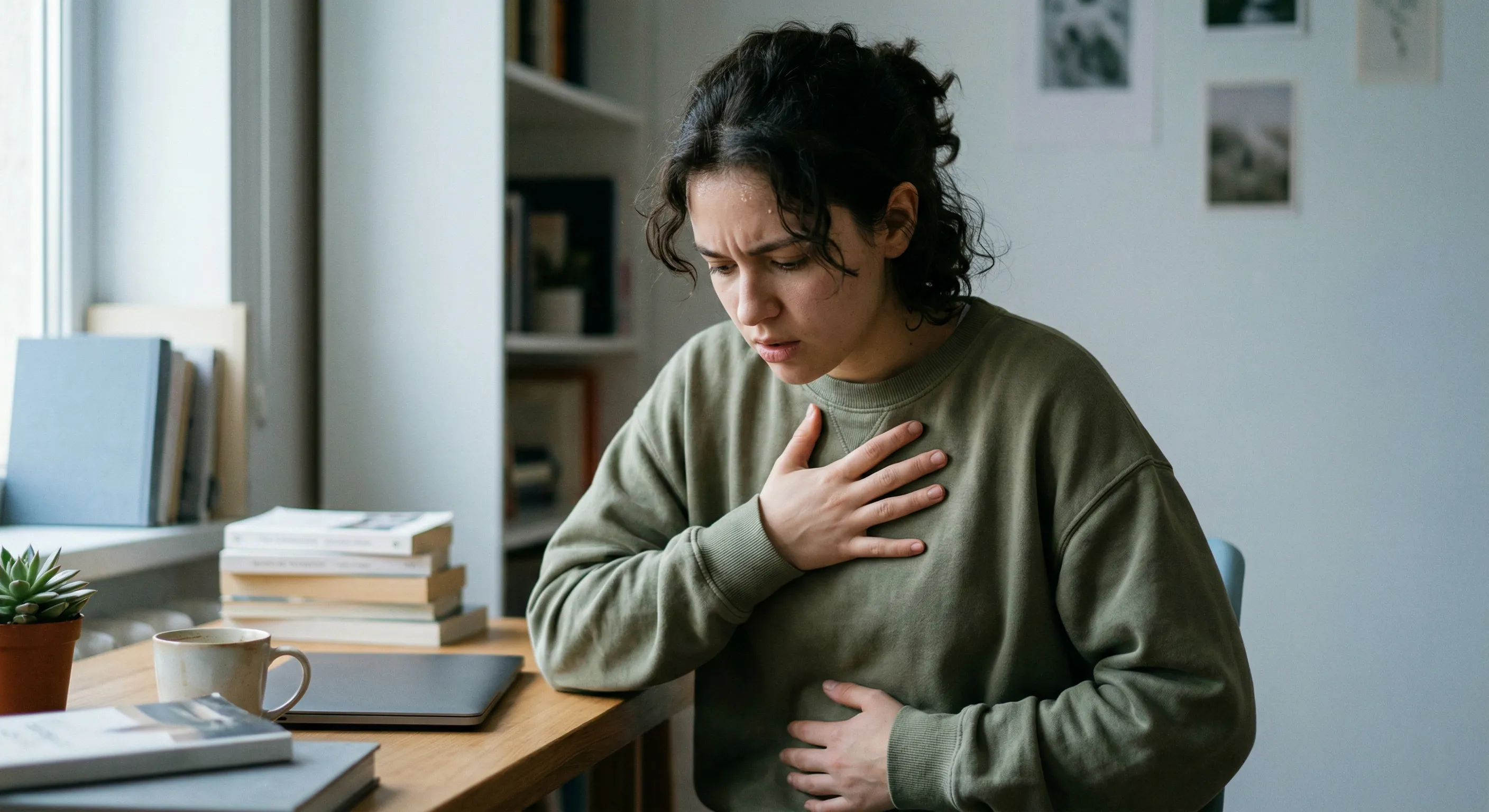
Quick Answer: Shortness of breath from anxiety is caused by the body’s fight-or-flight response, which triggers rapid, shallow breathing – even without physical danger. Signs it’s anxiety-related include breathlessness that appears during stress or panic, resolves when you calm down, and isn’t linked to exertion. It often comes with chest tightness, racing thoughts, or a sense of dread. If symptoms are frequent or severe, a clinical evaluation can help rule out cardiac or pulmonary causes.
You’re sitting at your desk, not doing anything physically demanding, and suddenly – you can’t get a full breath. It’s unsettling. Your mind immediately goes somewhere dark: Is something wrong with my heart? My lungs?
Here’s what most people don’t know: anxiety is one of the most common – and most overlooked – causes of unexplained breathlessness. The symptoms are real. The discomfort is real. But the origin isn’t always where you think.
What Anxiety Actually Does to Your Breathing
Anxiety Disorders are defined as conditions in which the body’s stress-response system activates disproportionately to actual threat levels. When anxiety kicks in, the sympathetic nervous system – the branch responsible for the fight-or-flight response – floods the body with adrenaline. Heart rate climbs. Muscles tense. And breathing shifts from slow, diaphragmatic breaths to fast, shallow ones from the chest.
This is called hyperventilation, and it doesn’t always look dramatic. You don’t have to be gasping at the edge of a panic attack to experience it. Sometimes it’s just a persistent feeling that you can’t get a satisfying breath, or that your chest is slightly too tight – all day, even at rest.
That’s anxiety working on your body without announcing itself.
The Key Signs That Shortness of Breath Is Anxiety-Related
Not every breathing issue is anxiety. And not every case of anxiety-related breathlessness looks the same. But there are reliable patterns.
It comes on with emotional triggers. If your breathlessness spikes before a difficult conversation, during a stressful commute, or when you’re lying awake at 2am running worst-case scenarios – that’s a significant signal. Anxiety-induced dyspnea is tied to psychological context, not physical exertion.
It improves when you calm down. Breathlessness from cardiac or pulmonary conditions doesn’t ease up because you took ten slow breaths or stepped away from a stressful situation. Anxiety-driven breathlessness often does. Slow, diaphragmatic breathing – where the belly rises rather than the chest – interrupts the sympathetic nervous system response and typically brings relief within minutes.
It comes packaged with other anxiety symptoms. Shortness of breath rarely travels alone when anxiety is the cause. Watch for chest tightness, a racing heart, tingling in the hands or feet, dizziness, or an overwhelming sense of dread. The presence of these somatic symptoms alongside breathlessness points strongly toward an anxiety disorder rather than a respiratory or cardiac cause.
It doesn’t match up with physical effort. If you’re breathless after climbing stairs, that warrants a different conversation with your doctor. But if breathlessness hits when you’re calm, sedentary, or in a situation that feels threatening even if it isn’t – that pattern is characteristic of generalized anxiety disorder (GAD) or panic attacks.

When to Rule Out Something Else First
Here’s the honest truth: you shouldn’t self-diagnose breathlessness as anxiety without first speaking to a medical professional. Conditions like asthma, anemia, cardiac arrhythmia, and pulmonary embolism can present with similar symptoms and require urgent attention.
Red flags that warrant immediate evaluation include breathlessness that worsens with exertion, comes with pain radiating to the jaw or left arm, appears suddenly without any emotional trigger, or is accompanied by bluish lips or fingertips. These are not anxiety. These need emergency care.
Once a physical cause has been ruled out – or alongside treating a physical condition – anxiety becomes a very reasonable explanation to explore.
What Actually Helps
The most evidence-supported treatment for anxiety disorders, including those that produce physical symptoms like breathlessness, is cognitive behavioral therapy (CBT). CBT is a type of therapy that helps people identify thought patterns, driving their anxiety response, and replacing them with more grounded, realistic thinking. Research published by the American Psychological Association consistently supports CBT as the first-line psychological treatment for anxiety.
Diaphragmatic breathing exercises, progressive muscle relaxation, and mindfulness-based approaches are also effective tools – not as replacements for therapy, but as complements to it. When anxiety is severe or significantly impacts daily function, medication management alongside therapy may also be appropriate.
The key insight – and one worth sitting with – is that anxiety-induced shortness of breath isn’t “imaginary.” It’s a physiological response driven by mental health conditions. Treating it means treating anxiety, not just breathing.
Ready to Take the Next Step?
The sooner you get help, the sooner healing begins. Talk to our team now.
Get Help Now!Frequently Asked Questions
A: Yes. People living with chronic generalized anxiety disorder or persistent panic disorder can experience breathlessness as a near-daily symptom. When breathlessness is frequent without a clear physical cause, it’s worth speaking with a mental health professional.
A: Anxiety-related breathlessness typically appears during emotional stress, improves with calming techniques, and comes with other anxiety symptoms like racing thoughts or chest tightness. Heart-related breathlessness tends to worsen with physical activity and may be accompanied by chest pain, jaw pain, or swelling in the legs. A doctor can run tests to distinguish between the two.
A: Yes – diaphragmatic breathing directly counteracts the hyperventilation triggered by the fight-or-flight response. Breathing slowly from the belly, rather than the chest, signals to the nervous system that the perceived threat has passed, which can reduce symptoms within minutes.
A: Cognitive behavioral therapy (CBT) is the most well-researched option. For anxiety that’s deeply tied to trauma, EMDR therapy may also be helpful. An intensive outpatient program can provide structured support if anxiety is significantly disrupting daily life.
A: If breathlessness from anxiety is affecting your quality of life, happening frequently, or making you avoid situations out of fear, it’s time to speak with a mental health professional. Early intervention leads to better outcomes.