
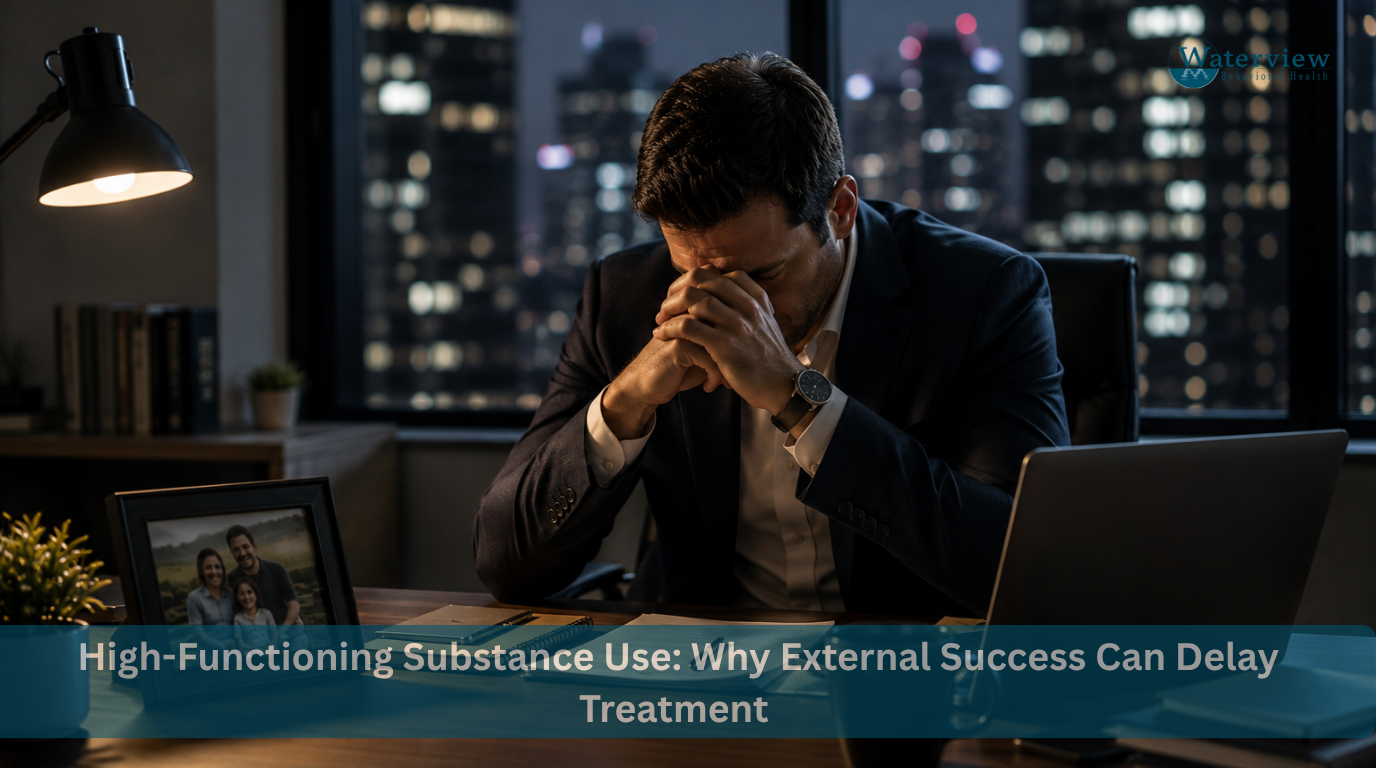
When most people picture substance use disorder, they picture visible crisis: a lost job, a broken marriage, an empty bank account, a DUI. Those experiences are real, and they happen to plenty of people. But they’re not the whole picture.
Plenty of people keep performing well at work, keep showing up for their families, keep their public image polished, all while privately using alcohol or other substances in ways that feel harder and harder to control. They’re the person everyone leans on. The high achiever who never misses a deadline. The parent who somehow keeps the household running. The professional whose reputation seems like it should rule out the possibility that they need help.
This is often called “high-functioning” substance use. It’s a useful phrase in one sense, since it names something real. But it can also mislead. “High-functioning” isn’t a clinical term, and it doesn’t mean someone is healthy, safe, or actually in control. It just means the consequences haven’t become visible to other people yet, or that the person has found ways to compensate for them.
For providers, families, and the individuals themselves, that distinction matters a lot. When success on the outside masks what’s happening on the inside, recognition and treatment get pushed further down the road. And the longer a problem gets treated as manageable simply because life still looks fine, the more room the disorder has to grow.
What High-Functioning Substance Use Can Look Like
It rarely looks dramatic from the outside. It might look like someone who drinks heavily most nights but is at their desk by 8 a.m. It might look like someone using substances to cope with stress, sleep problems, pain, anxiety, social pressure, or plain exhaustion, while still checking every box that’s expected of them. It might look like use that’s quietly becoming more frequent, more secretive, or more central to how someone gets through the day, even though nothing catastrophic has happened yet.
Some patterns show up again and again: setting limits and then blowing past them, needing more of a substance to feel the same effect, thinking constantly about the next chance to use, using alone or hiding it, getting irritable when use gets interrupted, brushing off a loved one’s concern, or leaning on a substance just to shift gears between work, parenting, sleep, and everything else.
People in this position often measure themselves against someone worse off and conclude they’re fine. “I still have my job.” “My family’s fine.” “I pay my bills on time.” “Nobody can tell.” Those things might all be true, and still not be the whole story. Substance use disorder isn’t defined by how much someone has already lost. It’s defined by loss of control, compulsive use, craving, and continuing to use despite the harm or risk it creates.
Why External Functioning Does Not Equal Clinical Health
Functioning and health overlap, but they aren’t the same thing. Someone can hold down a job and still be clinically unwell. Someone can look composed in a meeting and still be dealing with withdrawal symptoms, disrupted sleep, mental fog, rising anxiety or depression, shame, or a tolerance that keeps climbing. Someone can meet every obligation on their calendar while quietly burning enormous energy hiding, compensating, recovering, or bargaining with themselves about their use.
This distinction matters a great deal in clinical practice. Many people put off treatment because they use outward stability as evidence the problem isn’t serious. But substance use can do real damage long before anything falls apart publicly. Health can decline without anyone noticing. Relationships can grow strained while technically staying intact. Work performance can slip in quiet ways: reduced focus, less creativity, more fatigue, shorter tempers, without ever tipping into an obvious failure.
Research backs this up. A 2015 study published in Alcohol and Alcoholism looked at employed adults with alcohol use disorder and found they reported worse work performance, more presenteeism, and a heavier physical health burden than employed adults without the disorder. Having a job didn’t cancel out the toll the disorder was taking.
The same logic holds more broadly: things can look stable on the surface while real distress and real medical risk build underneath it.

The Role of Denial, Minimization, and Comparison
High-functioning substance use tends to be protected by one story: “It’s not that bad.” That story can be hard to argue with, because on the surface, it often looks accurate. The person hasn’t lost their job. Their relationships are still standing. Their finances are intact. Colleagues still respect them.
But “not that bad” tends to be a moving target. As tolerance builds or consequences pile up quietly, the definition of what would actually count as a problem keeps shifting. Maybe they once said they’d stop if they started drinking alone, and then drinking alone became routine. Maybe they said they’d stop if their partner said something, and then the partner’s concern got waved off as overreacting. Maybe they said they’d stop if it hit their work, and then the missed focus and the mistakes got chalked up to stress instead.
Comparison plays a role too. It’s easy to look at someone with more visible impairment and decide, by contrast, that everything’s under control. But clinical need was never about how someone else is doing. Nobody has to hit rock bottom before support becomes appropriate.
Providers can help by steering the conversation away from labels and toward patterns instead: What is this person using, and how often? What happens when they try to cut back or stop? What role does the substance play day to day? What are they managing, avoiding, or protecting by using it? And what is it already costing them, even quietly?
Why High Achievers May Be Especially Vulnerable to Delay
People who are used to excelling often struggle hardest with admitting they’ve lost control of something. Their sense of self is frequently built on competence, discipline, and being the one others depend on. Needing help can feel like it contradicts everything that identity is built on.
They’re also usually very good at compensating. A high achiever might work extra hard to mask fatigue, over-prepare to cover for mental fog, lean on routine to hold things together, or quietly recover from use while still showing up for every commitment. Those coping strategies can keep functioning intact for a while, but they also make the underlying problem easy to miss, including for the person living it.
Professional stigma adds another layer. Clinicians, executives, attorneys, healthcare workers, teachers, first responders, and other people in high-responsibility roles often worry about reputational fallout, licensing issues, judgment from colleagues, or losing people’s trust. Parents and caregivers may worry about being seen as unfit. These fears push people toward secrecy, and secrecy tends to deepen shame and delay treatment even further.
It’s worth saying plainly: seeking treatment isn’t a failure of character or competence. It’s a health decision. For a lot of people, getting help early is actually the most responsible move they can make for their career, their family, and their long-term wellbeing.
The Hidden Costs of Keeping Life Looking Normal
Part of what makes high-functioning substance use so draining is that the person is essentially running two lives at once: the visible one that looks put-together, and the private one shaped by cravings, self-imposed rules, exceptions to those rules, recovery time, and the constant low hum of fear about being found out.
That hidden effort carries a real emotional cost. Guilt after using. Anxiety about whether anyone’s noticed. Short-temperedness when routines get disrupted. Shame about needing a substance just to relax, sleep, socialize, or feel like themselves. Over time, isolation tends to creep in too, since keeping a secret makes honest connection harder.
Relationships can be affected long before they visibly break. The people close to someone using this way often sense distance, mood swings, defensiveness, or inconsistency they can’t quite name. Trust erodes slowly. The person using may become less present emotionally, not because they’ve stopped caring, but because so much of their attention is tied up in staying in control and staying hidden.
Physical health can also decline before any single crisis forces the issue: disrupted sleep, stomach problems, blood pressure changes, worsening anxiety or depression, trouble concentrating, a higher risk of accidents or medication interactions. Waiting for something dramatic to happen often means missing the earlier, easier moments to step in.
Why Crisis-Based Messaging Often Misses This Population
A lot of treatment messaging is built around the idea of hitting bottom: stop before you lose your job, your marriage, your health, your future. That framing resonates with some people. But for someone who still looks stable from the outside, it can fall flat. If they haven’t experienced those losses, the warning simply doesn’t seem to apply to them.
A more effective approach tends to focus on values and prevention rather than loss. Instead of asking only “what have you lost,” it helps to ask: What is this costing you right now? What are you working so hard to keep hidden? How much energy does all of this actually take? What would your life look like if you didn’t have to plan around using? What matters to you that this pattern could eventually put at risk?
Motivational interviewing fits well here, since it doesn’t rely on confrontation or shame. It helps someone sit with their own ambivalence, get clear on their values, and notice the gap between how they’re living and how they actually want to live. For someone who’s still functioning on paper, that’s often a far more useful starting point than a conversation built entirely around consequences that haven’t happened yet.
Treatment Before Collapse Is a Strength, Not a Last Resort
One of the most important shifts in thinking here is that treatment doesn’t have to wait for an emergency. Getting help before things fall apart can actually work in someone’s favor clinically. When a job, a home, relationships, and physical health are all still relatively intact, there’s more stability to lean on while engaging in treatment and building a recovery plan.
Getting ahead of the problem gives people room to look honestly at their use, build real coping tools, address anxiety or depression running alongside it, repair communication with the people close to them, and put relapse-prevention strategies in place before things get harder. It also gives them space to figure out what level of care actually fits.
Not everyone needs the same setting. Some people do well with outpatient therapy, medication support, mutual-help groups, or recovery coaching. Others need something more structured, like an intensive outpatient program, especially when substance use is tangled up with mental health symptoms, family stress, work pressure, or a string of attempts to quit that haven’t stuck.
The point isn’t to wait until the problem becomes impossible to ignore. If someone is even asking whether their use is a problem, that question is worth taking seriously.
When Providers Should Consider a Referral
High-functioning substance use shows up across all kinds of clinical settings: primary care, outpatient therapy, psychiatry, emergency care, workplace wellness programs, family systems work. Because it rarely announces itself, screening and genuine curiosity matter.
A referral is worth considering when a patient describes repeated failed attempts to cut back, rising tolerance, using to manage mood or sleep, withdrawal symptoms, secrecy, concern from people close to them, trouble concentrating, risky use, or continuing to use despite medical, emotional, occupational, or family fallout.
It’s also worth considering when substance use shows up alongside depression, anxiety, trauma symptoms, suicidal thoughts, heavy stress, or family conflict. Even if someone is still working and meeting their responsibilities, those co-occurring symptoms raise the stakes and make structured treatment more clinically appropriate.
How that referral gets framed matters too. Language like “you don’t have to wait for this to become a crisis to get support” or “the fact that you’re still functioning doesn’t mean this isn’t taking a toll” can go a long way toward reducing shame. It helps patients understand treatment isn’t a punishment. It’s a proactive step.
How Waterview Behavioral Health Can Help
Waterview Behavioral Health offers structured outpatient support for adults who need more than a weekly therapy session but don’t necessarily need inpatient or residential care. For people dealing with high-functioning substance use, that middle tier of support can matter a great deal, since it opens the door to treatment before life has fully come apart.
Waterview’s intensive outpatient programming is built to support people working through mental health concerns, substance use concerns, and co-occurring needs in a clinically grounded setting. Care may include group therapy, individual support, psychiatric involvement when it’s called for, skills-based work, relapse-prevention planning, and coordination with referral partners as clinically appropriate and authorized.
For referral sources, Waterview aims to be a genuine partner in the continuum of care. Many patients who look successful from the outside still need structured support to interrupt patterns that have become harder to manage on their own, in private. A referral to IOP can give those patients a more intensive therapeutic framework while helping them stay connected to their outpatient providers and daily responsibilities where clinically appropriate.
If you’re a provider working with a patient whose substance use is becoming harder to control, even though they’re still employed, housed, and outwardly stable, Waterview can help assess whether IOP is an appropriate next step.
Ready to Take the Next Step?
Acute symptoms don’t wait, and you don’t need to face them alone. Our team provides timely, evidence-based care to help you regain stability and move forward with confidence.
Frequently Asked Questions
Is “high-functioning substance use” a clinical diagnosis?
Not really, no. It’s more of a descriptive term people use for someone who keeps meeting most of their day-to-day responsibilities while still dealing with problematic substance use underneath it. Someone can look completely functional on paper and still meet the criteria for a substance use disorder.
Can someone have a substance use disorder without losing their job or relationships?
Yes, absolutely. What actually defines the disorder is a pattern: things like impaired control, cravings, rising tolerance, withdrawal, and continuing to use even when it’s causing harm or real risk. Big, visible losses happen for some people, but they’re not a requirement. Plenty of people meet the criteria long before anything falls apart on the outside.
Why do people put off treatment even when they’re still functioning?
A lot of the time, people point to their own success as proof the problem isn’t that serious. Shame plays a role too, along with stigma, worry about professional fallout, family obligations, and comparing themselves to someone who seems worse off. There’s often this underlying belief that treatment is only for people in full-blown crisis, when in reality, getting help earlier tends to work better.
What are some signs that high-functioning substance use might need treatment?
Some common ones: repeatedly breaking the limits you set for yourself, using more than you meant to, hiding it from people, needing a substance to relax or fall asleep, feeling anxious or on edge when you can’t use, dealing with withdrawal symptoms, noticing your tolerance keeps climbing, having a loved one bring up concerns, or continuing to use even as it takes a toll on your health, emotions, work, or relationships.
What level of care actually fits?
That depends on the person, honestly. Safety, withdrawal risk, any mental health symptoms in the mix, the specific pattern of use, the support someone has around them, and whatever treatment they’ve already tried all factor in. Some people do fine with outpatient therapy. Others need the structure that comes with an intensive outpatient program, or something even more involved. A proper clinical assessment is really the best way to figure out what fits.