
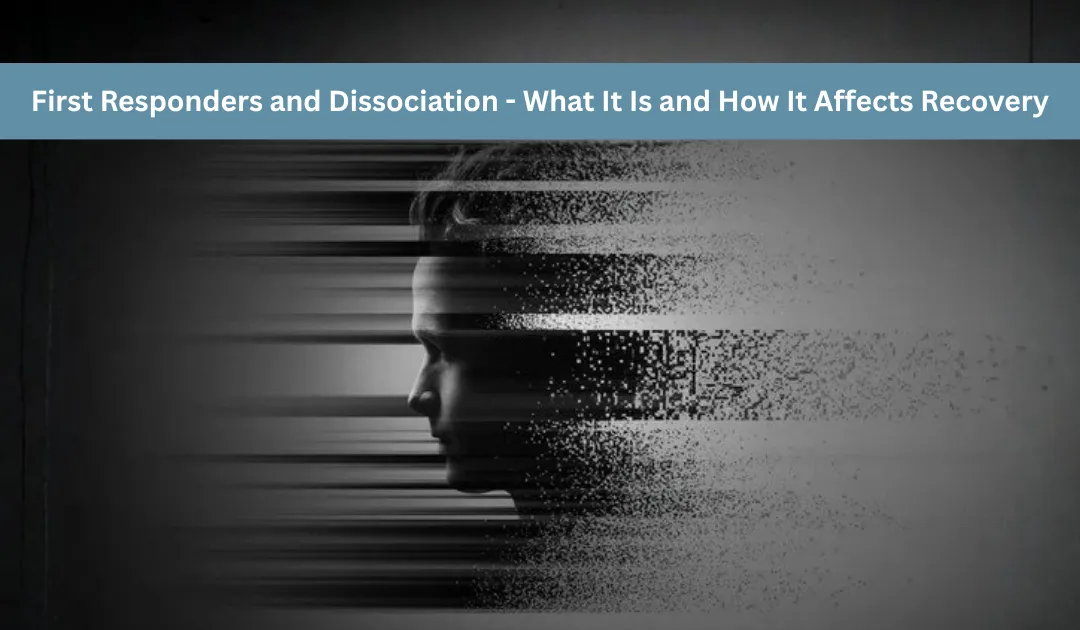
Dissociation gets less clinical attention in first responder populations than hyperarousal or avoidance, partly because the presentations are more subtle, partly because they’re easier to explain away as stress or fatigue, and partly because the field has historically focused more on the hyperactivation end of the trauma response spectrum.
But dissociation is present in a meaningful subset of first responders, and understanding it matters both for clinical assessment and for trauma-informed treatment planning.
What Dissociation Actually Is
Dissociation is a disruption in the normally integrated functions of consciousness, memory, identity, or perception. It exists on a spectrum. At the mild end: highway hypnosis, losing track of time while doing a routine task, momentarily feeling detached from one’s surroundings. At the severe end: depersonalization, derealization (the world seeming unreal), identity disruption, and dissociative amnesia.
In PTSD, the DSM-5 includes a dissociative subtype, characterized by prominent depersonalization and derealization, that is distinct from the more typical PTSD presentation with dominant hyperarousal features. Research suggests that the dissociative subtype may be more common in people with early-onset trauma, greater trauma severity, and greater adverse childhood experience history. This presentation falls under the broader category of dissociative disorders seen in clinical practice.
How Dissociation Presents in First Responders
In clinical settings, first responders with dissociative features often describe: going through shifts on autopilot, feeling like they’re watching themselves from outside, not fully feeling present at home, periods of time that are difficult to account for, and an emotional flatness that’s deeper than numbing, as if the connection between experience and self is intermittent.
The challenge is that autopilot and compartmentalization are also occupationally valued and often described as functional rather than symptomatic. The clinician’s job is to distinguish between adaptive compartmentalization and dissociative detachment, not always straightforward, but clinically important.

Dissociation vs. Other Trauma Responses
Dissociative symptoms are sometimes mistaken for the emotional numbing seen in mood disorders or the hypervigilance typical of anxiety disorders. A careful differential is important, since co-occurring conditions are common – dissociation can also overlap with symptoms seen in schizo-affective presentations or emerge alongside substance use disorders when individuals self-medicate dissociative numbing.
Why Dissociation Matters for Treatment
The dissociative subtype of PTSD responds somewhat differently to standard trauma-focused treatments. Research by Resick, Briere, and others has found that exposure-based treatments (Prolonged Exposure, EMDR) need to be modified for people with prominent dissociation – specifically, stabilization and grounding work needs to precede or accompany exposure, because people who dissociate during exposure processing don’t process effectively.
This is one of the reasons why Mission Reset’s curriculum includes EMDR grounding as a component, building the stabilization and grounding capacity that allows more intensive trauma processing work to be effective for this population. This approach is integrated into the broader therapeutic modalities used across our PTSD and trauma program.
Screening and Clinical Assessment
Providers assessing first responders should include specific questions about dissociative experiences. The Dissociative Experiences Scale (DES) is a brief, validated screening tool, particularly when presenting clinical complexity that doesn’t fully explain response to standard treatment approaches. This kind of structured intake is a core part of our admissions process.
Levels of Care for Dissociative Trauma Presentations
Depending on symptom severity and functional impact, treatment may take place across different levels of care, including our Intensive Outpatient Program (IOP) or Partial Hospitalization Program (PHP). For first responders specifically, our First Responder IOP in Connecticut and broader veteran and first responder mental health programming are built around this population’s occupational culture and stigma concerns.
Ready to Take the Next Step?
The sooner you get help, the sooner healing begins. Talk to our team now.
Get Help Now!Frequently Asked Questions
No. Brief lapses in attention happen to everyone and aren’t clinically significant on their own. Dissociation involves a more pervasive disruption in how consciousness, memory, identity, or perception are integrated – things like losing time, feeling detached from your own body, or watching yourself “from outside” during a shift. The distinction is frequency, intensity, and whether it interferes with functioning.
Yes. Dissociative symptoms exist on a spectrum and can appear in people who don’t meet full criteria for PTSD, including those with dissociative disorders on their own, or as a feature of trauma-related conditions more broadly. A proper evaluation helps clarify whether dissociation is the primary issue or a secondary feature of another condition.
For people with prominent dissociative features, jumping straight into exposure-based processing (like Prolonged Exposure or unmodified EMDR) can actually backfire – dissociating during the work prevents the brain from processing the memory effectively. That’s why stabilization and grounding skills typically come first, building the capacity to stay present before deeper trauma work begins.
That depends on symptom severity, safety, and how much dissociation is affecting daily functioning at work and home. Our team conducts a clinical assessment during the admissions process to recommend the right starting point, whether that’s IOP, PHP, or a specialized track like Mission Reset for first responders.